PF-05231023 (AbMole, M10048) is a long-acting analog of fibroblast growth factor 21 (FGF21). Its molecular structure consists of two modified FGF21 monomers conjugated to an IgG1 κ antibody scaffold. FGF21 is a 19 kDa endocrine hormone that regulates lipid and glucose homeostasis. The N-terminus of FGF21 binds to several fibroblast growth factor receptors (FGFRs), including FGFR1c, FGFR3c, and FGFR4, while its C-terminus primarily binds to the membrane-associated cofactor β-klotho. Although FGF21 has shown promise in animal models of metabolic diseases, its short half-life of 0.5–2 hours limits its application [1]. This is mainly due to its low molecular weight. While fusion protein technology can increase molecular mass, it often compromises the structural integrity of the N- and C-termini, which are critical for the regulatory activity of PF-05231023 [2].
PF-05231023 is generated by site-specifically conjugating two modified FGF21 molecules to a non-targeting IgG1κ antibody scaffold (CVX-2000) via genetic engineering, forming a bivalent FGF21 CovX-Body. Introducing a cysteine residue at position A129 in FGF21 as the conjugation site avoids activity loss associated with N- or C-terminal coupling. This design significantly extends the half-life of FGF21, achieving a 70-fold increase in mice compared to wild-type FGF21 (37 hours after subcutaneous injection). In non-human primates, PF-05231023 has a half-life of 65 hours and a bioavailability of 68% [3].
AbMole provides global researchers with high-purity, high-bioactivity inhibitors, cytokines, human monoclonal antibodies, natural products, fluorescent dyes, peptides, compound libraries, antibiotics, and other research reagents, widely cited in numerous publications and patents worldwide.
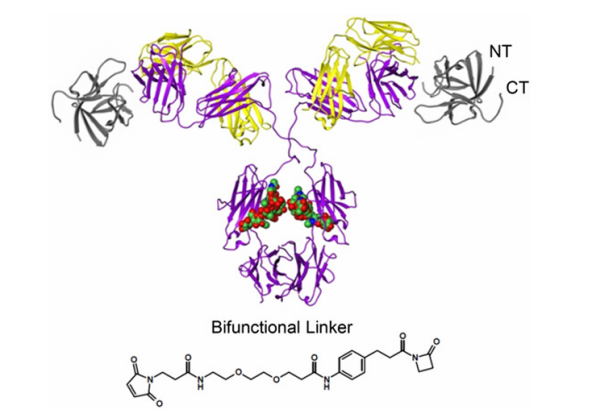
Structure and design mechanism of PF-05231023 [1]
PF-05231023 (AbMole, M10048) significantly inhibits hepatic lipid accumulation in animal models, reduces adipocyte hypertrophy in white adipose tissue, and ameliorates lipid metabolism disorders by downregulating lipid synthesis-related genes in adipose tissue transcriptomes[4]. Moreover, PF-05231023 reduces body weight in animal models by affecting the central nervous system and decreasing food intake. Studies have confirmed that the weight loss induced by PF-05231023 in cynomolgus monkeys and diet-induced obese mice is primarily due to reduced food consumption[5].
PF-05231023 is also used in animal models of nonalcoholic steatohepatitis (NASH). In diet-induced NASH mouse models, PF-05231023 significantly reduces body weight, hepatomegaly, plasma transaminase levels, and plasma/hepatic lipid levels, while also improving liver fibrosis [6]. The mechanism involves inhibition of hepatic lipid droplet accumulation and reduction of adipocyte hypertrophy in white adipose tissue.
PF-05231023 has important applications in animal models of diabetes and its complications. For example, in insulin-deficient diabetic mice, PF-05231023 activates the AKT-Nrf2 pathway, reduces IL-1β expression in photoreceptor cells, protects retinal neuron function, and ameliorates diabetes-induced retinal dysfunction and photoreceptor segment disruption [7].
In 2014, two inhibitors from AbMole were used in in vivo studies by the Spanish National Center for Cardiovascular Research (CNIC) and Columbia University, leading to research publications in Nature and Nature Medicine.
Case Study
J Adv Res. 2025 Mar;69:477-494.
A research team from Wenzhou Medical University investigated the role and mechanism of FGF21 in a mouse model of septic liver injury. They found that FGF21 inhibits septic liver injury via the autophagy/HIF-1α axis. Specifically, FGF21 activates the FGFR receptor, inhibits the mTOR signaling pathway, restores impaired autophagic flux in macrophages during sepsis, promotes p62-mediated autophagic degradation of HIF-1α, and reduces pro-inflammatory cytokine release and hepatic inflammatory infiltration. PF-05231023 (AbMole, M10048), a long-acting FGF21 analog, was used to inhibit pathological progression and significantly improve survival in septic mouse models. Furthermore, PF-05231023 effectively inhibited the activation of pro-inflammatory macrophages in mice [8].
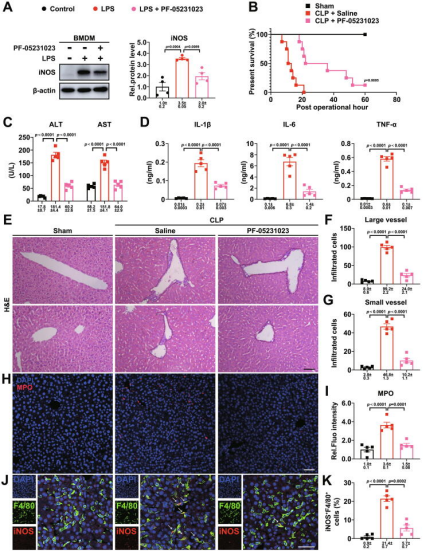
PF-05231023 protects mice against septic liver injury [8]
The products described herein are for research use only.
References and Acknowledgments
[1] Jie Huang, Tetsuya Ishino, Gang Chen, et al., Development of a novel long-acting antidiabetic FGF21 mimetic by targeted conjugation to a scaffold antibody, 346(2) (2013) 270-280.
[2] Junming Yie, Randy Hecht, Jennifer Patel, et al., FGF21 N-and C-termini play different roles in receptor interaction and activation, 583(1) (2009) 19-24.
[3] J. Huang, T. Ishino, G. Chen, et al., Development of a novel long-acting antidiabetic FGF21 mimetic by targeted conjugation to a scaffold antibody, The Journal of pharmacology and experimental therapeutics 346(2) (2013) 270-80.
[4] J. Zhao, X. Liu, J. Yue, et al., PF-05231023 reduces lipid deposition in apolipoprotein E-deficient mice by inhibiting the expression of lipid synthesis genes, Frontiers in veterinary science 11 (2024) 1429639.
[5] W. C. Thompson, Y. Zhou, S. Talukdar, et al., PF-05231023, a long-acting FGF21 analogue, decreases body weight by reduction of food intake in non-human primates, Journal of pharmacokinetics and pharmacodynamics 43(4) (2016) 411-25.
[6] M. H. Nielsen, M. P. Gillum, N. Vrang, et al., Hepatoprotective effects of the long-acting fibroblast growth factor 21 analog PF-05231023 in the GAN diet-induced obese and biopsy-confirmed mouse model of nonalcoholic steatohepatitis, American journal of physiology. Gastrointestinal and liver physiology 324(5) (2023) G378-g388.
[7] Z. Fu, Z. Wang, C. H. Liu, et al., Fibroblast Growth Factor 21 Protects Photoreceptor Function in Type 1 Diabetic Mice, Diabetes 67(5) (2018) 974-985.
[8] J. Zhu, Z. Jin, J. Wang, et al., FGF21 ameliorates septic liver injury by restraining proinflammatory macrophages activation through the autophagy/HIF-1α axis, Journal of advanced research 69 (2025) 477-494.