Selisistat (EX527, AbMole, M1708) is a potent and highly selective inhibitor of SIRT1 (Sirtuin 1). Selisistat (CAS No.: 49843-98-3) binds to the complex of SIRT1 and nicotinamide adenine dinucleotide (NAD+), thereby blocking the deacetylase activity of SIRT1. In research, Selisistat serves as a key tool for investigating SIRT1 function. For example, in metabolic studies, Selisistat (EX527) was used to reveal that SIRT1 regulates PPARα protein stability, showing that SIRT1 inhibition prevents ubiquitin-mediated degradation of PPARα[1]. In tumor models, Selisistat, alone or in combination with Paclitaxel, inhibits tumor growth via mechanisms involving cell cycle regulation and metabolic reprogramming[2]. In neuroscience, Selisistat (EX527) influences microglial phenotype switching by inhibiting SIRT1, thereby altering the production of inflammatory cytokines and reactive oxygen species[3]. In virology, downregulating SIRT1 activity with Selisistat significantly inhibits hepatitis B virus replication[4]. Selisistat also affects various other cellular processes through SIRT1 inhibition. For instance, in inflammatory responses, Selisistat (EX527) reverses the SIRT1-activating effects of Resveratrol, thereby attenuating its anti-inflammatory activity[5]. In oxidative stress models, Selisistat treatment reduces mitochondrial function and promotes apoptosis[6]. Selisistat has also been used to elucidate the role of SIRT1 in autophagy[7]. In skin hair follicle regeneration studies, Selisistat promotes hair regrowth by inhibiting the ferroptosis pathway [8].
Case Study
Int J Biol Sci. 2022 Jan 31;18(4):1594-1611
In the above study, researchers from the Shanghai Institute of Materia Medica, Chinese Academy of Sciences, and Shanghai University of Traditional Chinese Medicine investigated the potential of Atractylenolide III (ATL III), a bioactive compound derived from Atractylodes macrocephala, to inhibit non-alcoholic fatty liver disease (NAFLD) and its possible mechanisms. The study found that ATL III alleviated liver injury and lipid accumulation in high-fat diet (HFD)-induced NAFLD mouse models and free fatty acid (FFA)-treated HepG2 cells by activating the AdipoR1-mediated AMPK and SIRT1 signaling pathways. In this study, researchers used Dorsomorphin (Compound C, AbMole, M2238) and EX 527 (Selisistat, AbMole, M1708) as inhibitors of the AMPK and SIRT1 pathways, respectively, confirming that both pathways are essential for the biological activity of Atractylenolide III. In cell experiments, the CCK-8 kit (AbMole, M4839) was also used to verify the effect of Atractylenolide III on the viability of FFA-treated HepG2 cells [9].
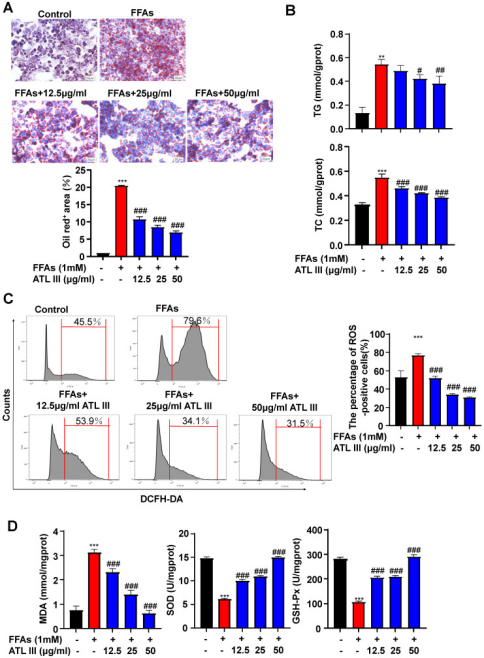
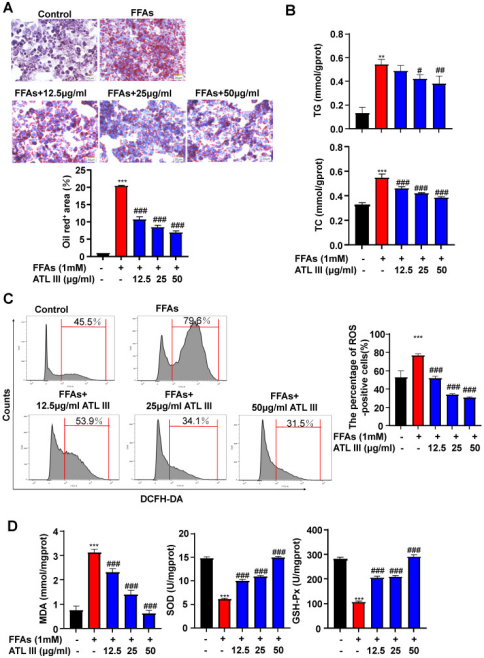
ATL III administration reduces FFAs-induced lipid accumulation in HepG2 cell
References and Acknowledgments
[1] J. H. Suh, K. H. Kim, M. E. Conner, et al., Hepatic PPARalpha Is Destabilized by SIRT1 Deacetylase in Undernourished Male Mice, Frontiers in nutrition 9 (2022) 831879.
[2] A. Wawruszak, J. Luszczki, D. Bartuzi, et al., Selisistat, a SIRT1 inhibitor, enhances paclitaxel activity in luminal and triple-negative breast cancer: in silico, in vitro, and in vivo studies, Journal of enzyme inhibition and medicinal chemistry 40(1) (2025) 2458554.
[3] J. Zhu, P. Jin, T. Zhou, et al., SIRT1 modulates microglia phenotypes via inhibiting drp1 phosphorylation reduces neuroinflammation in heatstroke, Brain research bulletin 218 (2024) 111101.
[4] W. Zhang, J. Cui, L. Li, et al., Notoginsenoside R1 inhibits hepatitis B virus replication by modulating SIRT1 activity, Acta virologica 67(1) (2023) 51-58.
[5] X. M. Chen, Y. J. Guo, H. W. Ling, et al., The Effect of Resveratrol in Sirt1/CST Pathway to Inhibit TNF-alpha Induced Inflammatory Response in Rat Primary Fibroblast-Like Synoviocytes, Biological & pharmaceutical bulletin 46(11) (2023) 1592-1600.
[6] Y. Wang, Q. Yang, S. Shen, et al., Mst1 promotes mitochondrial dysfunction and apoptosis in oxidative stress-induced rheumatoid arthritis synoviocytes, Aging 12(16) (2020) 16211-16223.
[7] P. Cao, Y. Wang, C. Zhang, et al., Quercetin ameliorates nonalcoholic fatty liver disease (NAFLD) via the promotion of AMPK-mediated hepatic mitophagy, The Journal of nutritional biochemistry 120 (2023) 109414.
[8] Z. Zeng, B. Wang, M. Ibrar, et al., Schizochytrium sp. Extracted Lipids Prevent Alopecia by Enhancing Antioxidation and Inhibiting Ferroptosis of Dermal Papilla Cells, Antioxidants (Basel, Switzerland) 12(7) (2023).
[9] Q. Li, J. X. Tan, Y. He, et al., Atractylenolide III ameliorates Non-Alcoholic Fatty Liver Disease by activating Hepatic Adiponectin Receptor 1-Mediated AMPK Pathway, International journal of biological sciences 18(4) (2022) 1594-16