Pepstatin A (AbMole, M3657) is a naturally occurring peptide compound produced by Actinomycetes. Its chemical structure features two unique statine residues ((3S,4S)-4-amino-3-hydroxy-6-methylheptanoic acid), which enable potent inhibition of aspartic protease family members. X-ray crystallography studies have shown that the hydroxyl group of the statine residue in Pepstatin A (CAS No.: 26305-03-3) forms a stable hydrogen bond network with the two catalytic aspartic acid residues in the active site of aspartic proteases (with an inhibition constant Ki as low as 0.072 μM). This mode of interaction endows Pepstatin A with the ability to inhibit enzymes such as pepsin, cathepsin D, and cathepsin E[1].
AbMole provides global researchers with high-purity, high-bioactivity inhibitors, cytokines, human monoclonal antibodies, natural products, fluorescent dyes, peptides, compound libraries, antibiotics, and other research reagents, widely cited in numerous publications and patents worldwide.
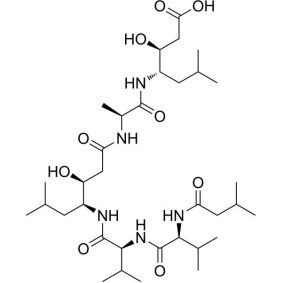
In experimental settings, Pepstatin A (AbMole, M3657) is frequently used in autophagy-related research, often in combination with E-64d (Aloxistatin, AbMole, M2376) to block the lysosomal degradation pathway. This inhibitor combination effectively blocks the final degradation step of the autophagic flux by inhibiting lysosomal proteases, leading to the accumulation of autophagosomes and lysosomes within cells. For example, co-treatment with Pepstatin A and E-64d induced the accumulation of the autophagy marker LC3-II in starved HEK293 and HeLa cells, indicating blockade of autophagic flux [2]. Pepstatin A also exhibits diverse inhibitory activities in viral replication suppression. Studies have demonstrated that Pepstatin A effectively inhibits the activity of viral proteases (e.g., ASPRV1 protease), thereby restricting viral replication[3]; it also interferes with viral hydrolysis of chemokines by inhibiting cathepsin D activity, affecting HIV replication [4]; furthermore, Pepstatin A broadly suppresses viral replication by upregulating apoptosis-associated tyrosine kinase (AATK), and AATK knockout significantly attenuates the antiviral effect of Pepstatin A[5]. Pepstatin A also influences amyloid precursor protein processing via inhibition of cathepsin D. For instance, in APP/PS1 transgenic mouse models, Pepstatin A (10 mg/kg) reduced β-amyloid plaques in the cerebral cortex by 35%, accompanied by downregulation of the microglial activation marker CD68[6], offering new perspectives for mechanistic studies in neurodegenerative animal models such as Alzheimer’s disease. Pepstatin A also induces inhibition of RANKL-induced osteoclast differentiation in a dose-dependent manner, an effect that is independent of cathepsin D and other proteases and primarily involves blockade of the ERK signaling pathway [7].
In 2014, two inhibitors from AbMole were used in in vivo studies by the Spanish National Center for Cardiovascular Research (CNIC) and Columbia University, leading to research publications in Nature and Nature Medicine.
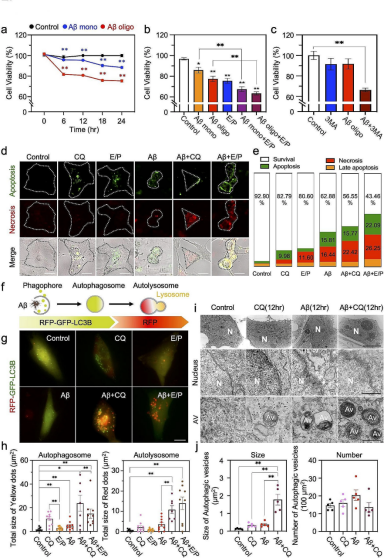
Blockage of autophagy pathway decreases survival of astrocytes in response to Aβ oligomer [6]
The products described herein are for research use only.
References and Acknowledgments
[1] R. E. da Silva-Lopez, T. A. A. de Araujo, H. J. J. Monteiro, et al., Study of protease activity from Aspergillus awamori INCQS2B.361U2/1 extracellular fraction and modification of culture medium composition to isolate a novel aspartic protease, Brazilian journal of microbiology : [publication of the Brazilian Society for Microbiology] 53(3) (2022) 1599-1611.
[2] Isei Tanida, Naoko Minematsu-Ikeguchi, Takashi Ueno, et al., Lysosomal turnover, but not a cellular level, of endogenous LC3 is a marker for autophagy, 1(2) (2005) 84-91.
[3] M. Golda, J. A. Motyan, K. Nagy, et al., Biochemical Characterization of Human Retroviral-Like Aspartic Protease 1 (ASPRV1), Biomolecules 10(7) (2020).
[4] O. A. Arodola, M. E. Soliman, Hybrid 2D/3D-quantitative structure-activity relationship and modeling studies perspectives of pepstatin A analogs as cathepsin D inhibitors, Future medicinal chemistry 10(1) (2018) 5-26.
[5] L. Zhao, R. Song, Y. Liu, Glycolytic metabolite phosphoenolpyruvate protects host from viral infection through promoting AATK expression, European journal of immunology 53(12) (2023) e2350536.
[6] Suhyun Kim, Heejung Chun, Yunha Kim, et al., Astrocytic autophagy plasticity modulates Aβ clearance and cognitive function in Alzheimer’s disease, 19(1) (2024) 55.
[7] Hajime Yoshida, Kuniaki Okamoto, Tsutomu Iwamoto, et al., Pepstatin A, an aspartic proteinase inhibitor, suppresses RANKL-induced osteoclast differentiation, 139(3) (2006) 583-590.