Thirty-two such combinations were evaluated and VE-821 in vivo showed that single agents, did not substantially alter growth, and only certain combinations suppressed growth. The extent of growth fold inhibition was calculated by dividing the alamarBlue fluorescence values for the PF-04217903 treated cells with fluorescence values for cells treated with the vehicle. With the aim of translating the drug combinations to possible human use, we eventually focused only on drugs currently approved by the FDA that targeted the RTKs mutated in GBM. Erlotinib did not show significant inhibition even at a concentration of 100 mM. Lack of erlotinib activity may be attributed to its low solubility in DMSO compared to gefitinib and was therefore eliminated from the subsequent analysis. Remaining were these four inhibitors: gefitinib, imatinib, sunitinib and sorafenib. To test for synergistic cytotoxic effect on GBM oncospheres, one tenthand one fourth the IC50 values were next used. Single drugs and pair-wise combinations of these drugs were analyzed in GBM oncosphere lines for proliferation and caspase induction. Drug combinations containing sunitinib were best at inducing apoptosis, and the best combination for inhibiting growth appeared to be gefitinib plus sunitinib. To investigate the differences observed in the growth inhibition and caspase assay of the GBM oncospheres, the ability of the oncospheres to recover and proliferate following treatment with RTK inhibitors was analyzed. Cells were treated with RTK inhibitors at 25% of IC50 concentrations for 24 hours. The drugs were withdrawn after 24 hours and the ability of the oncospheres to regrow was assessed after two additional weeks of culture in the growth media using alamar blue cell growth assay. The growth assessment revealed that oncospheres treated with single agents or with the combination of RTK inhibitors were able to regrow with the exception of the cells treated with the combination of gefitinib and sunitinib. Moreover, observation of the cells treated with the drugs with light microscopy revealed that cells treated either with single agents or combinations of RTK inhibitors other than gefitinib and sunitinib were able to form oncospheres, whereas the cells treated with a combination of gefitinib and sunitinib were unable to form oncospheres. 020913 cells formed fewer neurospheres when treated with sunitinib compared to gefitinib reflecting the growth inhibition seen earlier in alamar blue assay. This observation suggests that gefitinib and sunitinib forms a specific combination that effectively inhibits growth of GBM oncospheres. The goal of this work was to determine if we could find a combination of approved RTK inhibitors that might be superior to single agent therapy, and test this combination in preclinical animal models of glioblastoma. Monotherapy of RTK targeting agents have been largely ineffective and there is enough in vitro experimental evidence to support the use of combination therapy targeting multiple tyrosine kinases. We first identified possible effective RTK combination using in vitro cell proliferation studies. Next we planned to test efficacy in improved preclinical animal models at FDA approved doses to try and mimic what might be achievable in a clinical trial. In this study, gefitinib and sunitinib was the best in vitro combination, based on its ability to reduce proliferation 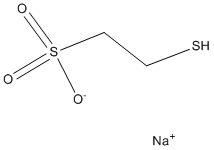 and kill GBM oncospheres. The pattern of effective inhibitor combinations suggests that successful simultaneous inhibition of EGFR and PDGFR and other tyrosine kinases was necessary.
RTK inhibitors were tested for growth suppression of their respective IC50 concentrations
Leave a reply
 such as DNA repair, cell division, signaling, protein degradation and notably, innate immune function. Ubiquitination occurs by covalent attachment of an,8.5 kDa ubiquitin molecule to a lysine residue in the target protein by the sequential action of three enzymes; a ubiquitin-activating enzyme, a ubiquitin-conjugating enzyme and a ubiquitin-ligase enzyme. Ubiquitin is removed from proteins by deubiquitinases by proteolysis. The human genome encodes over 100 proteins that possess putative DUB activity but physiological substrates of these proteins remain poorly defined for most. DUB enzymes have established roles in a broad spectrum of diseases such as cancer, viral infection and neurodegenerative disorders. Although the function of most DUBs in immune regulation is not known, a few are key players in the modulation of innate immunity and inflammation. For example, the deubiquitinases, A20 and CYLD, control NF-kB signaling, a critical pathway in immunity and cell survival.
 problems, telomeres shorten each time human somatic cells divide and this attrition limits their lifespan. Once the shortest telomere become uncapped, a DNA damage response is induced that mobilizes the p53 and p16/pRB pathways, which then act together to induce senescence, a viable state of irreversible quiescence. If the p53 and p16/pRB pathways are disabled, the cells will ignore these growth inhibitory signals and will continue to divide and shorten their telomeres. Eventually, terminal telomere shortening lead to crisis, a non-viable state associated with programmed cell death. Crisis is triggered by recurrent cycles of telomeretelomere fusions, anaphase bridges and chromosome breakage. When present, telomerase can prevent the induction of senescence and crisis and extend cellular lifespan by the synthesis and addition of new telomeric repeats to the telomeres. Telomerase is ubiquitously present in the early stages of human development. But by the time of birth, expression of the enzyme is repressed and telomerase becomes absent from most somatic tissues, including the pancreas. Cancer specimens, in stark contrast to normal tissues, are
  an antibody against H7 but not antibodies against H1, H3 or H5. In addition, H7N9pp infection was also sensitive to bafilomycin A1 and dynasore as well as other influenza A viruses. These findings suggest that H7N9pp could mimic the influenza virus entry process. Recent studies have demonstrated that the novel H7N9 virus can bind to both avian-type and humantype receptors. These presented us questions about whether the changed Receptor-Binding ability of the novel H7N9 viruses can affect tropism.
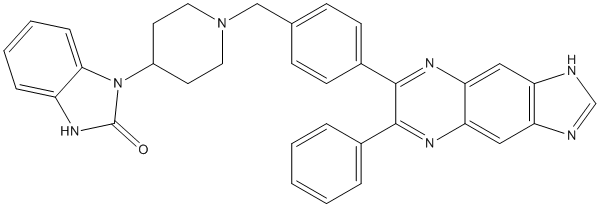 acid residues at the PB1 and PB2 interface that include His538 and Lys540 from PB2 to form pivotal electrostatic interactions. The unique physical properties of the Plk1-PBD make it an attractive target for designing inhibitors with great specificity and potency.