It will be highly interesting in future investigations to determine the effects of the seminal plasma-specific posttranslational modifications on PCI functions, such as the inhibition of various proteases and cell-surface receptor interactions. However, protease inhibition experiments will require the isolation of active seminal plasma-derived PCI, which has proven to be very difficult to achieve, due to the high concentrations of serine proteases in seminal plasma. Alternatively, it may be possible to produce recombinant PCI expressing the seminal plasma PCI N-glycans, although this is a difficult task because it requires the precise expression of the correct glycosyltransferases. A recent study indicates that PCI could also play another functional role in the human male and female BU 4061T reproductive systems. The immune lectin designated DC-SIGN is associated with both mature and immature dendritic cells. Many human pathogens bind to DC-SIGN, enabling their VE-822 detection, uptake and the development of specific adaptive immune responses by DCs. However, DC-SIGN also binds to several endogenous glycoproteins, and such interactions are currently thought to promote immune homeostasis. Many proteins are specifically produced in the male urogenital tract after the onset of puberty, but they have not been subjected to thymic education. Such autoantigens could trigger immune responses in both the human male and female reproductive systems. However, PCI and three other glycoproteins have recently been defined as endogenous glycoprotein ligands for DC-SIGN in seminal plasma. Extensive fucosylation was important for these interactions. Therefore seminal plasma PCI could also have an immunomodulatory effect in both the male and female reproductive tracts, in which fucosylation plays a critical role. The results presented here provide further support that posttranslational modifications affect the functional specificity of PCI, which is medically relevant because PCI can act for instance as an anti-inflammatory and antitumor agent. It is also essential for all stages of reproduction. Therefore it may be used for therapeutic purposes. It was previously shown that the overall removal of Nlinked glycans and the NH2-terminal peptide of PCI affect the inhibition rates in the presence but not in the absence of the cofactors heparin and thrombomodulin. For factor Xa, the NH2-terminal peptide of PCI was found to affect the inhibition rates both in the absence and the presence of heparin. PSA, in contrast, is unique in that only  the combination of the N-glycans and the NH2-terminus of PCI affect the rate of its inhibition. Estrogens are important steroidal hormones which exert different physiological functions. The main beneficial effects include their role in programming the breast and uterus for sexual reproduction, controlling cholesterol production in ways that limit the build-up of plaque in the coronary arteries, and preserving bone strength by helping to maintain the proper balance between bone build-up and breakdown. Among female sex hormones, 17b-estradiol is the most potent estrogen carrying out its action either via transactivation of estrogen receptors or by stimulating nongenomic effects via the MAPK signaling pathway. In addition to its important beneficial effects, however, E2 can also cause serious problems arising from its ability to promote the cell proliferation in breast and uterus. Although this is one of the normal functions of estrogen in the body, it can also increase the risk of estrogen dependent diseases, like breast cancer, endometriosis and endometrial hyperplasia. Suppression of estrogenic effects is consequently a major therapeutic approach.
The shedding caused by the N-glycans and the NH2-terminus together is not affected by the charge of the N-glycans
Leave a reply
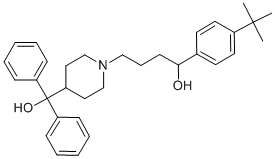 have been categorizing novel ligands for their properties in T-cell differentiation. The above data support that SU5416 enhances Treg generation in vitro, and that IDO is generated in pDCs in response to SU5416 in vitro in an AHR-dependent manner. We continue to characterize these effects for multiple ligands, and are considering theories explaining these differences including the potency and duration of binding of the ligands to the receptor, a possible change in conformation of the receptor when different ligands bind, and a possible effect on APC-T cell interactions. That being said, there is some data to suggest that these dichotomous findings are not as clear cut as originally thought. Most of the in vitro studies examining effects on T-cell
  inhibitory small molecules, which are not yet available. Annexin A2 is strongly expressed in lungs, aorta, heart, adrenals and small intestine. Intracellular AnxA2 is part of a heterotetramer complex comprising two AnxA2 monomers and two copies of its natural binding partner, p11. AnxA2 is composed of an N-terminal 23 aa segment that binds p11, followed by four repeat structures. Although lacking a signal peptide, AnxA2 is translocated to the cell surface through a p11-dependent mechanism and is found at the cell surface of epithelial and endothelial cells. As a co-receptor for plasminogen and tissue plasminogen activator, which are required for plasmin generation, the AnxA2 complex promotes vascular fibrinolysis. It was suggested that injection of AnxA2 in human may improve thrombotic disease outcome. AnxA2 knockout mice are viable, but deficient in endothelial plasminogen processing into plasmin and neoangiogenesis. We previously identified AnxA2 as a natural inhibitor of PCSK9’s function on the LDLR, through binding of the first R1 repeat domain of AnxA2 to the CHRD. Inhibition likely occurs via an allosteric PCSK9 conformational change induced by AnxA2, similar to what was reported for mAbs that bind the CHRD. In this report, we investigated in more details the molecular interaction of the R1 domain of AnxA2 and PCSK9 and showed that a synthetic peptide spanning the R1 domain is a potent inhibitor. We further hypothesized that PCSK9 is much more active in enhancing LDLR degradation in AnxA22/2 mice. Indeed, our data showed that AnxA22/2 mice exhibit a higher level of
  pharmacokinetics and pharmacodynamics of different DPP-4 inhibitors, in the settings of CRF, in order to determine the properties of DPP-4 inhibitors to be used in patients with impaired renal function, and investigated the effects of linagliptin on biomarkers of cardiac and renal fibrosis. The results showed that DPP-4 inhibition increases plasma GLP-1 levels, particularly in uremia, suggesting that linagliptin may offer a unique approach for treating uremic cardiomyopathy in CKD patients. The overall goal of the present study was to compare the pharmacokinetic properties of available DPP-4 inhibitors in a rat model of uremic heart disease and select the optimal compound based on these data for the first pharmacodynamics analyses of potential efficacy in this rat model. We have shown that renal impairment does not affect the pharmacokinetics of linagliptin, whereas it increases the exposure of sitagliptin and alogliptin. In the present study, only linagliptin was found not to further aggravate pathological changes of glomerular and tubular markers in rats with CRF, suggesting that it is a safe approach to be used in patients with CRF. Consequently, linagliptin was also the compound of choice to investigate further effects on uremic cardiomyopathy. This is of potential clinical impact, since patients with advanced stages of renal impairment are characterized by a high overall cardiac morbidity and mortality.
 day after bleeding, and 4) both, MMP-3 and TIMP-3 are significantly decreased during the first days after spontaneous SAH. Numerous studies suggest a crucial role of MMP-9 in the pathophysiology of aneurysmal SAH. Downregulation of proinflammatory mediators – including MMP-9 – was found to