However, two factors influence the formation of bone tissue: the local milieu and the maintenance of stem cells in situ. Immunogenicity may be removed from freeze-dried bone allografts but cortical bone remains dense. This scenario is not conducive to permitting cells and nutrients to penetrate bone. Hence, we created many pores on the bone allograft scaffolds to permit the penetration of cells and nutrients. Fibrin glue was used in this study to maintain the position of the stem cells. Several studies have suggested that fibrin glue can be used for cell delivery because it is a biocompatible and biodegradable tissue adhesive that stabilizes seeded cells and provides an equally distributed population of cells throughout the carrier. Authors have demonstrated that fibrin glue does not inhibit the proliferation of bonemarrow MSCs. In this study, allogeneic bone began to absorb 1 month after transplantation in the experimental group. Absorption was significant 3 months after transplantation and new bone was formed at this time. The size of new bone was smaller than that of the original bone allograft scaffold, and almost all the bone allograft scaffold was CAY10505 replaced by new bone 1 year after transplantation. However, in the control group, the bone allograft was not absorbed 1 year after transplantation. The speed of the formation of new bone was slower than that observed in the experimental group. Approximately 30% of allogenic bone was replaced by new bone. It is possible that more dense bone was formed at the cortical bone, and therefore angiogenesis was slower. Resorption of allogeneic bone in the experimental group was significantly greater, and formation of new bone faster, than that seen in the control group. These findings demonstrated that the mechanism of healing of bone allografts changed when bone marrow-derived MSCs were loaded onto the scaffolds. It is possible that the addition of cells with high osteoblastic potential could enhance the bone appositional phase from the early stages of remodeling. Nevertheless, investigation of the specific underlying mechanism merits further study. However, histological analysis has shown that although almost all transplanted allogeneic bone was replaced by new bone in the experimental group, most of it was fibrous ossification. MSCs have the potential for multilineage differentiation into osteoblasts, chondrocytes, adipocytes, myocytes, cardiomyocytes, and neurons, amongst others. They can differentiate into osteoblasts in the presence of osteoinductive factors 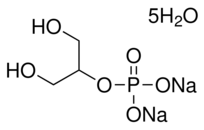 or an osteogenic environment. In this study, we used scaffolds and seed cells, and did not add Indinavir sulfate growth factors during the reconstruction of hemi-mandibular defects. Although the freeze-dried bone contain many growth factors such as BMP, the presence of growth factors in the freezedried bone was very limited. These limited growth factors could not have induced MSCs to differentiate into osteoblasts. It is possible reason that most of the “new bone” was fibrous ossification. In future studies, we will add growth factors such as BMP to assess whether more optimal results can be gained. In summary, we have demonstrated that tissue-engineered bone could be created using bone allograft scaffold-loaded autologous marrow MSCs. MSCs accelerate the speed of absorption of bone allografts and ossification. The major drawback is infection, as two beagles from control group and one beagle from experimental group had postoperative wound infections, and future studies will be needed to determine ways to reduce the rate.
Both bone and cartilage formation boosting the MSCs among cells with cartilage forming capacity
Leave a reply
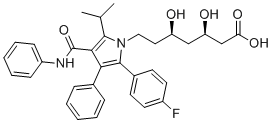 the brain tissue response after ICH. However, the neuroprotective effect of AM let7c in the in vitro thrombin injury model was validated in the vivo ICH model, in which apoptotic cell death was reduced by promoting IGF1R signaling. Only the intranasal delivery of AM let7c was studied in this study, although there is a chance that other administration routes such as intracerebral injection could be more efficient. Future studies regarding dose response, time window, as well as the route of administration will help to strengthen the feasibility of miRNA modulation strategy in ICH. In conclusion, we demonstrated a distinct miRNA expression pattern after ICH and its modulation can have therapeutic potential. The let7c antagomir reduced cell death and inflammation, and enhanced neurological recovery by activating the IGF1R pro-survival pathway. This suggests blocking let7c might be a potential therapeutic target in ICH. A variety of hormones or neurotransmitters, such as adrenaline, dopamine, and prostaglandins, stimulate specific G protein-coupled receptors and activate or suppress adenylate cyclase, leading to an increase or decrease in cAMP. Cyclic AMP directly binds and activates at least three effectors, protein kinase A, exchange protein directly activated by cAMP, and cyclic nucleotidegated channels, and mediates various cellular functions via distinct pathways. Because some cAMP effector proteins are localized only in specific subcellular components, spatial and temporal cAMP dynamics are crucial for regulation of various cellular functions. For investigation of spatial and temporal dynamics of intracellular messenger molecules, such as Ca2+, cAMP and cGMP, two types of genetically-encoded fluorescent indicators have been developed. These indicators are Fo��rster resonance energy transfer -based ratiometric indicators and single fluorescent protein -based intensiometric indicators. FRET-based ratiometric indicators enable monitoring of dynamics of intracellular molecules by a ratio of fluorescence intensity change at two different wavelengths. FP-based intensiometric indicators enable monitoring of dynamics of intracellular molecules by a change in fluorescence intensity of a single wavelength. To monitor cAMP dynamics in cells, several FRET-based cAMP sensors have been
 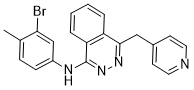 days. Epidemiological studies have reported an RRT requirement of approximately 2.6% to 4.9%. Our lower incidence of RRT was associated with the fact that the need for dialysis treatment was evaluated only in the first seven days after surgery but the similarity of other studies suggests that although each center has different patient populations and criteria for indicating RRT, the average incidence of severe AKI requiring RRT is approximately 4%. In our study, the mortality of KDIGO stage 3 patients needing RRT peaked at 62%, in contrast with the mortality of patients without postoperative AKI. Although the mortality of patients treated with RRT after cardiac surgery declined, in most studies, this factor remained greater than 40%. We also found that age, female gender and CPB times are predictors of 30-day mortality after cardiac surgery. Age and female gender are traditional predictors of early and late mortality after cardiac surgery and are present in most contemporary operative risk scores. Many studies have found
 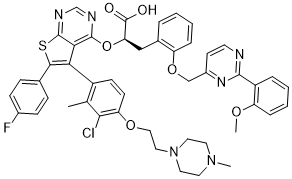 in line with other studies supporting an immunomodulatory role ascribed to miR-146a in several human neurodegenerative diseases associated with a strong inflammatory component. In fact, upregulation of miR146a has been detected in active multiple sclerosis lesions, in human Alzheimer diseasebrainand in prion disease, indicating an underlying common inflammatory response to different neurological insults. Accordingly, when normalized using the best combination of two or three reference genes, we observed that miR-146a transcript levels were significantly increased in the chronic stage. Interestingly, under our experimental conditions, the use of a reference gene individually for normalization leads to the relative transcript levels of the mir-146a gene to be different from those obtained with the best combinations of genes, and hence probably less accurate. This suggests, therefore, that an appropriate normalization strategy for miRNA expression during epileptogenesis requires the use of two or more reference genes. Curiously, in previous studies, under the same experimental conditions, in order to normalize protein-coding RNA expression, the use of just one of the stable reference genes produced a reliable measurement.
 studies have been performed study to evaluate the potential effects of DHEA supplementation according to these standards. This study is the first to examine the effect of DHEA in poor ovarian responder patients that fulfill the Bologna criteria. According to our results, although the oocyte and embryo numbers were similar between the two groups, DHEA administration was associated with significantly higher implantation and ongoing PRs. DHEA is a mild androgen, produced as an intermediate step by the adrenal glandsand ovariesduring steroidogenesis. The circulating levels of DHEA decline markedly with advancing age. It is a very important prehormone for sex steroidogenesis. In the ovarian follicle, DHEA is converted to androstenedione and estrone, the source of testosterone and estradiol according to the two-cell theory. Casson first speculated that exogenous administration of DHEA could restore ovarian follicular sex steroidogenesis in elderly women. Since then, a few controlled studies with small